The arithmetic of leverage, applied to how your business runs.
We redesign how work gets done — sharper processes, clearer decisions,
and systems that scale. We bring modern tools, AI among them, to bear exactly where they
earn their place, and nowhere they don't.
“We need more capacity” is almost never a capacity problem.
Nor is “our forecast is bad” usually a forecasting problem. You already know
the symptom. It is rarely the problem.
By the time anyone names it, the business has organized itself around it. A spreadsheet
exists to work around it. A step in the process exists only because of it. Nobody remembers why any
more — it is simply how the work gets done.
So we open with a differential, not a proposal: the competing causes, and the
one cheap test that tells them apart. Below are the twelve most common, and the test we would run for
each. All twelve, in full. No form.
Pick the one you have said out loud in the last month
The defect never changes. What changes is how much has been built on top of it.
A problem caught early is a policy change — an owner and a Tuesday. Left alone it
becomes a systems project, then a reorganization, then a capital case. Roughly a class per year.
Nothing about the defect moved; the workarounds around it did.
Archetype on the 1–10–100 escalation long used in quality management; the log
axis makes each order of magnitude an equal band. This is the concave half of convexity — the
stretch where delay compounds against you.
How we work
Four calls, always in that order.
The stages are fixed; only the methods inside them change. That is what lets one
small firm work across industries without pretending to industry tenure — the complaint
differs, the procedure does not.
01TriageWhich problem is this? One cheap computation
that eliminates the wrong answers. Days, not weeks — and it decides everything after it.
02DiagnoseWhat is driving it? Attribution across the
surviving explanations, from your own data. Evidence, not a workshop hypothesis.
03PrescribeWhat should we do? Optimization, simulation,
policy design. The impressive part — and deliberately the last one.
04TranslateWhat is it worth? Into cash, return on capital
or covenant headroom. Never a maturity score. This one is never optional.
Never skip to call three. An optimizer aimed at a misdiagnosed problem returns
a precise wrong answer, delivered with confidence. It is the most expensive mistake available and
the easiest one to make.
One decision, all the way through
A change on the shop floor and a change in the share price are the same arithmetic.
One lever moves one quantity. The quantity moves the identity. The identity is enterprise
value. Nothing in between is a matter of opinion — which is why the same engine can start
at a changeover time and end at a price per share.
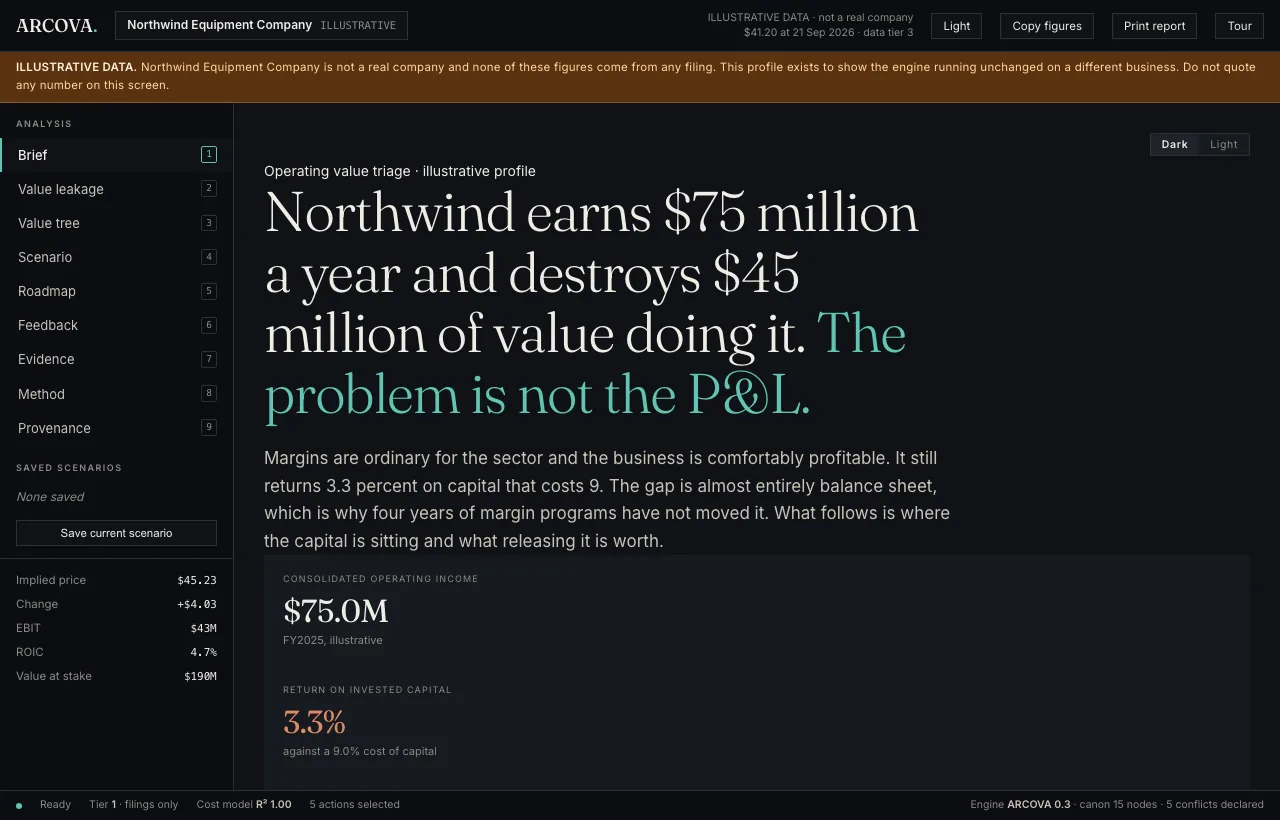
3.3% return on the capital employed, against a 9% cost of capital
— −$44.7m of value leaving every year, reported nowhere. That is the shape we
find most often.
The engine
Most engagements end in a deck. This one ends in a working model of your business.
ARCOVA is calls two, three and four running as software. It reads the filings, finds where
value is leaking, prices every action against the cost of capital, sequences them, and then
learns from what actually happened — which feeds straight back into the model and
changes what it recommends next. You can argue with it in the room and it will recompute
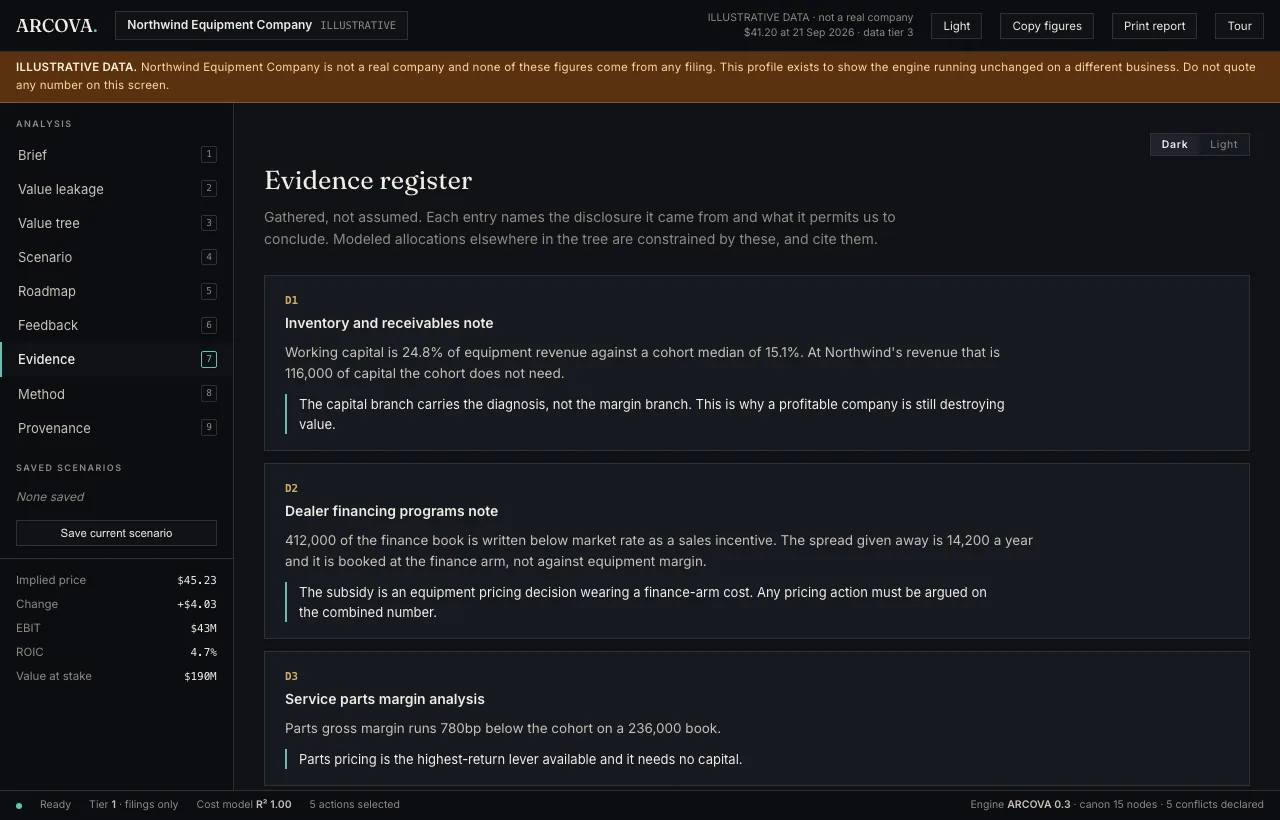
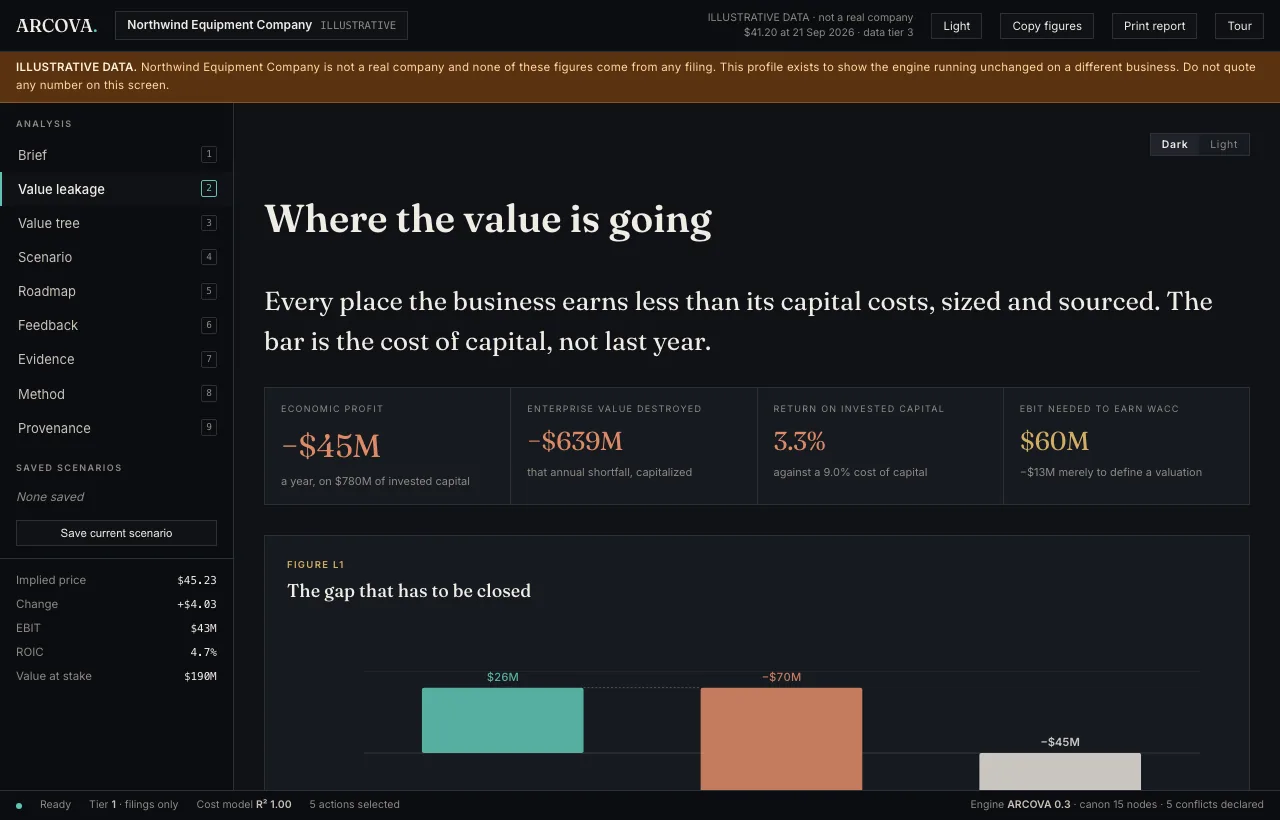
while you do. The screens below are the real product, on an illustrative company.
01
Gathered, not assumed
Every finding names the disclosure it came from and states what it permits you to
conclude — and, just as usefully, what it does not. Modeled figures elsewhere are
constrained by these and cite them, so nothing is asserted that cannot be walked back to
a line in a document.
Where two sources disagree, the conflict is declared and the position we
took is recorded. A skeptic should find our weakest link faster than we could hide it.
02
Where the value is going
The benchmark is the cost of capital, not last year. A business can be comfortably
profitable and still destroying value, and only one of those two facts shows up in the
management accounts. Every leak is sized, sourced and tied to the node it comes from.
Identified leakage deliberately exceeds the gap that has to be closed.
Not all of it is recoverable, and the overlaps are declared rather than quietly summed.
And round again
The engagement does not end at the recommendation.
Steps three to six are a cycle, not a sequence. Each result you report re-estimates the tree,
which changes the best combination, which reshapes the schedule, which sets up the next thing
to measure. The model of your business is worth more in year two than it was on the day we
handed it over — which is the opposite of how a deck ages.
What it refuses to compute
Any model can produce a number. The harder discipline is declining to, and each of these is
a rule in the code with a source behind it.
A consolidated multiple for a group with a captive finance arm. The method does not
apply, so it is declined rather than footnoted.
A going-concern value when return on capital sits below the growth rate. The
thresholds are reported instead — more useful to an operator than a suppressed number.
Netting an overfunded pension. Surplus plan assets cannot reach shareholders.
A peer figure that fails a plausibility check. Excluded and named, never guessed.
An action with no way to establish cause. Recorded as a hypothesis, not priced as a lever.
See it on your own numbers
There is no public login and no self-serve trial. We build your profile from your filings
before the first meeting, then run the engine live — your business, your constraints,
every figure traceable to the document it came from. The screens above are a demonstration
company; nothing on this page is real.
The engine scores the combinations. People decide what is worth scoring.
Enumeration is arithmetic, and arithmetic is reproducible. What is not reproducible is the
content it operates on. Before any number is computed, every action carries four things written
by hand: the thesis that makes it plausible, the test that would settle it, the way it fails,
and the source the rule came from. That last set is the part that took years, and the part a
competitor cannot generate.
And it does not rank the actions and take the top few — it scores every
combination of them. Ranking assumes the actions add up. They do not: relieve one constraint and
the next one binds, and two fixes drawing on the same scarce attention deliver less than either
promised alone.
The specification
The whole engine, in two pages.
What it reads, the eight stages it runs, the eight levers it moves, the nine analyses it
returns, and the things it refuses to compute. Everything the engine does, stated so it can
be argued with rather than admired.
We hunt for the small, well-placed changes that produce disproportionate results — and
we prove them before we build them. A process is a network. The work is finding the one point
where a small, precise change moves the whole outcome.
Convexity tells you what to change. Concavity tells you what order to
change it in — and the escalation curve above is what the wrong order costs while you wait.
A standing challenge
The first read is free, and it is on your company.
Nobody should have to commit to four weeks of consulting to find out whether a consultant is
right. So we do the first piece of work before you engage us, on public filings, at our own
cost — and you see a real number about your own business before anything is agreed.
We have also run this on named public companies, from their filings alone. Those case studies
are not published — a live company deserves to hear a conclusion about itself before the
internet does. We will walk you through one.
01The readPublic filings only. No access, no data request,
no time from your team. A couple of days, at our cost. You get the economic profit your business
is earning or destroying, where it is going, and which of the twelve it looks like. If the number
is small, we say so here.
02The conversationForty-five minutes. Thirteen questions
about how the business is actually built — who sets your price, whether you make to stock,
where the capital sits. A controller answers all of them without preparing.
03The engagementOnly if the read points somewhere worth
going — and quoted once we know which of the twelve it is.
Who we work with
The vocabulary is local. The structure is not.
The twelve above turn up in plants, in distribution networks, in capital programs and in professional
firms — described in completely different words each time. We work wherever a decision is data-rich,
expensive to reverse, and currently being made on instinct.
Manufacturers & processors
Capacity, changeover, scrap, delivery dates,
maintenance. Where the twelve were first written down.
Distribution & supply chain
Forecasting, inventory position, service levels
— and the working capital locked in the wrong place.
Multi-site operators & their investors
Which site is genuinely
underperforming, which is simply smaller, and where an operating plan should start.
Capital programs
Schedule risk that survives scrutiny, what acceleration
really costs, and whether to build, buy or wait.
Service & back-office operations
Claims, underwriting, clinical throughput,
shared services. Queues behave the same wherever they form.
Advisory & professional firms
Platform and data-model decisions that commit
the firm for years — and cost more to reverse than to make.
We are not sector specialists, and that is deliberate. A test that settles a capacity
question on a molding floor settles it in an emergency department too. We would rather show our working in
the first week than ask you to take tenure on trust.
Get in touch
Tell us your hardest problem
What's slow, manual, or stuck? Send it over and we'll tell you where the leverage is. No pitch, no obligation — just a straight read on whether we can help.